The delicious math of comedy
I’m currently working on a show for the Glimmerglass Opera Festival that proves comedy is math! Plus, how to think of a comedic scene to find the funny moments.


I’m currently working on a show for the Glimmerglass Opera Festival that proves comedy is math! Plus, how to think of a comedic scene to find the funny moments.
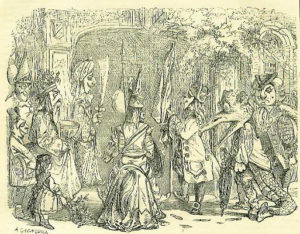
Got an event? Grab your friends, some archetypal and silly costumes, and do some mumming! What is mumming? Mumming arises out of the same tradition as sword dances, and ethnohistorians believe they both grew out of ancient agrarian societies. They have their origins in ritualized sacrifice to ensure the renewed fertility of the land and the people as well as the battle between the eternal opposites — the old and new year, winter and spring, the darkness and the light. In the past 200 hundred years, a group of Mummers might perform for members of a household, people on the
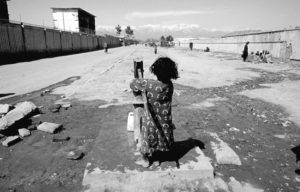
I learned just a few days ago that will be going back to Afghanistan in the fall of 2013—eleven years after my first incredible visit. I have the honor of going over with the Afghan Friends Network, and have begun making the flurry of arrangement even as my mind and heart are in wind and fire. I have realized that it is hard for many people to understand why this part of the world is so very compelling for me, so I share below an interview I did with Lillie Marshall of Teaching Traveling. Journey in peace, friends. “When people
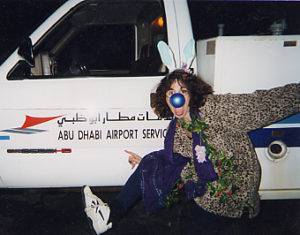
To follow up on part one, a history of clowning, this little section looks at ‘what is clowning’ and how that was understood early in the history of Islam in the Silk Road countries. What is clowning? The exchange of styles, skills, characterizations and so forth was (and is) facilitated by the itinerant nature of performers. Three main reasons why performing clowns traveled were: *The search for new markets *As part of royal court retinue (they were expected to accompany various court members) *Self-preservation; as laws changed and social pressure increased, it became in the clowns best interest to keep
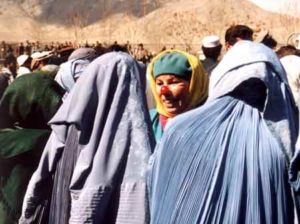
As some of you may know, my Master’s Thesis was called “The Search for Indigenous Clown Forms in Afghanistan” (of course it was), stimulated in part by participation in a humanitarian mission to Afghanistan in February of 2002 with the the Italian military, an Italian film crew, and approximately two dozen clowns, mostly Italian. My passion for Silk Roads clowning continues unabated. Thus, this blog entry! This is an excerpt (sadly made slightly ‘rumpled’ in tone in my attempt to cut words) from a paper I presented at a Silk Roads Conference in Australia. It also provides a working definition/explanation
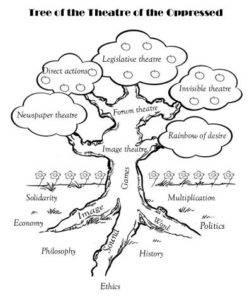
As I consider a recent production “The Pirates of Penzance” and the commedia masks I’ve made, I am reminded that the Performing Arts have been a form of protest since people gathered around a campfire and a storyteller wove critique into his or her tale, since the first time homo erectus cracked a joke at the expense of someone with more social power. Although the Performing Arts certainly include music (and I would count the haunting soundscape of the Casserole Protests, with their conscious ‘symphonizing’ of rhythm, volume, and melody, in this category), my emphasis here will be on protest
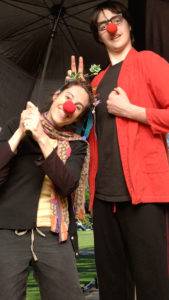
A colleague recently asked me for some opening exercises to do with a clown class. The class would include folks with a variety of challenges, from the usual “I don’t like being vulnerable with other people” to learning challenges to challenges that accompany Down Syndrome. What an AWESOME question and AMAZING project! There are sooooo many terrific clown activities to use and do—it’s an ancient, myriad, mulitplexed art form. Even its practice in a workshop setting can change how one feels in the world. I have included below ‘openers’ that are great for many workshops—not just clowning, not just theatre.
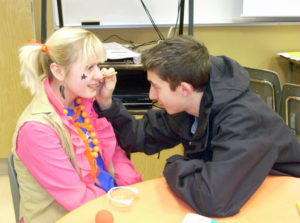
Many projects in the expressive arts have a built-in lifetime, and a part of the pleasure arises out of the pre-knowledge of the project’s life expectancy. Clown Therapy, projects, however, are not wrought, like a performance, but rather exist as a process, like the water cycle, where beings are drawn together, change, affect and are affected by their environment, are lifted up, then are quite literally expressed. Like water, the process itself does not need to have the same exact people in it all the time to feel continuous, although like water, repeated action in the same place and close
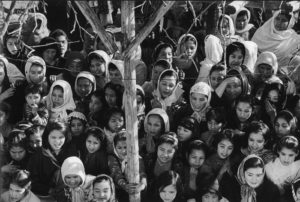
My Master’s Thesis was called “The Search for Indigenous Clown Forms in Afghanistan” (of course it was), stimulated in part by participation in a humanitarian mission to Afghanistan in February of 2002 with the the Italian military, an Italian film crew, and approximately two dozen clowns, mostly Italian. My passion for Silk Roads clowns continues unabated, and lately, people have been asking me more about them. Thus, this blog entry! This is an excerpt (sadly made slightly ‘rumpled’ in tone in my attempt to cut words) from a paper I presented at a Silk Roads Conference in Australia. It also