
Blog

Rebekkah, my daughter, poses in her princess costume before a show

The Courage of Art

Picture if you will, a starry-eyed performer and teaching artist. The year is 1996, and said artist has been on faculty at the Community School of Music and Arts in Ithaca, NY for about a year. A brand new program, Star Search, has a writer/vocal coach and a dance choreographer, but is without a theatre person…. and thus began my love affair with a project I have done, without fail and with supreme joy, every August since. What is Star Search? Star Search is a no-audition, 2-week camp for kids between the ages of 10 and 16 in which we
Read More »
Doing arts-based learning in an mixed proficiency classroom

Theatre Workshops and Kids with Autism = AWESOME

In June, I had the amazing opportunity to work with 3 Tier Consulting (http://3-tier.org/home/ check out some of their amazing blogs and work) and some fabulous kids who are also kids with Autism or Asperger’s Syndrome. We were doing theatre/dramatic play/acting and playbuilding exercises and games, partly because yes, those skills are what those kids need to analyze and memorize social cues and responses, but also because it’s fun and develops social awareness for anyone! Were they scared at first? HECK yes. Another opportunity to not understand what is going on and feel out of place. Great. But once they

Read More »
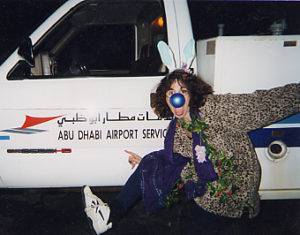
Holly poses in her clown makeup in front of a vehicle at the Abu Dhabi airport

Clowning: some what, some why, and a little history Part Two

To follow up on part one, a history of clowning, this little section looks at ‘what is clowning’ and how that was understood early in the history of Islam in the Silk Road countries. What is clowning? The exchange of styles, skills, characterizations and so forth was (and is) facilitated by the itinerant nature of performers. Three main reasons why performing clowns traveled were: *The search for new markets *As part of royal court retinue (they were expected to accompany various court members) *Self-preservation; as laws changed and social pressure increased, it became in the clowns best interest to keep

Read More »
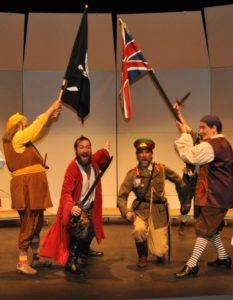
Pirates of Penzance-rollicking success!

Arts in Community: creating a smoother process flow

Whether you are directing a show or putting together a community pageant, you need a smooth process flow. Without one you’re likely to encounter major stress and early onset balding (or maniacal laughter…), not to mention a less positive outcome for all involved. Here’s a few tips to help it go well! Schedule Number one arch nemesis. Everyone has other things to do, there are different skill sets represented (and so, of course, different members of each subgroup have different needs), people forget, and things come up at the last minute. What are some steps you can take so as

Read More »
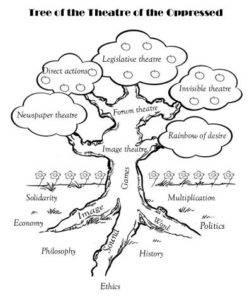
Diagram, Theatre of the Oppressed

Performance as Protest

As I consider a recent production “The Pirates of Penzance” and the commedia masks I’ve made, I am reminded that the Performing Arts have been a form of protest since people gathered around a campfire and a storyteller wove critique into his or her tale, since the first time homo erectus cracked a joke at the expense of someone with more social power. Although the Performing Arts certainly include music (and I would count the haunting soundscape of the Casserole Protests, with their conscious ‘symphonizing’ of rhythm, volume, and melody, in this category), my emphasis here will be on protest

Read More »
Holly Adams in her studio recording an audiobook

Pirates! In praise of swordplay

I love pirates. Not, of course, modern real-life pirates, but the pirates of history and fiction with whom I fell in love as a girl. I still remember the thrill I felt when I met my first wild and adventurous pirate, Sinbad the Sailor from 1001 Arabian Nights. I was a shy, bookish, wandering girl of 8 who spent long afternoons alone in the woods to recover from school where having both too much energy and an agile, hungry mind made me ….. well, let’s call it “less than popular”. My discovery of the swashbuckling, adventurous narrative saved me. To

Read More »
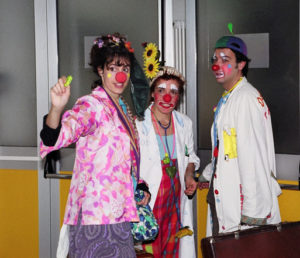
Three clowns in a hospital in Tuscany, Italy

A Mime is a Terrible Thing to Waste

(Sigh.) Let’s face it. I’m gonna let the truth be known. YES, I studied as a mime. I loved Shields and Yarnell (start with “The Breakfast Show”), Marcel Marceau, and the Mummenshanz, so it seemed natural to have intensive mime training as a part of my career development. I took workshops and courses, and enrolled in the renamed Dell ‘Arte School of Physical Theatre. As the official website beautifully frames it, “Originally called the Dell’Arte School of Mime and Comedy, the School’s name was changed to The International School of Physical Theatre in the late 1980s as a result of

Read More »
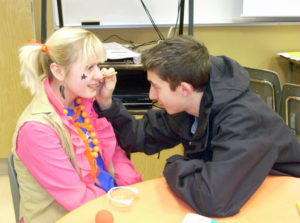
A boy puts makeup on a girl getting ready for her clown therapy session

Clown Therapy Projects: love at first nose

Many projects in the expressive arts have a built-in lifetime, and a part of the pleasure arises out of the pre-knowledge of the project’s life expectancy. Clown Therapy, projects, however, are not wrought, like a performance, but rather exist as a process, like the water cycle, where beings are drawn together, change, affect and are affected by their environment, are lifted up, then are quite literally expressed. Like water, the process itself does not need to have the same exact people in it all the time to feel continuous, although like water, repeated action in the same place and close

Read More »
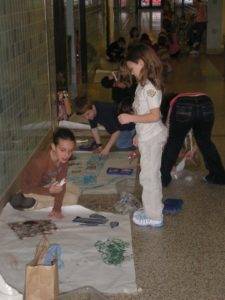
A group of kids paints on the floor of a hallway

Theatre for Discovery & Transformation: Prince Ahmed and Peribanou

For many years, the Canada Centre for Faith and Social Justice held monthly open meetings, and at each meeting, they would go through four phases in order to bring the social forces and ‘pre-scribed’ relationships into greater transparency. The four phases are: Identifying Ourselves and Our Interests Naming Issues Assessing Forces Planning For Action Why is that important? Many of us in Arts and Arts-in-Ed do work based in an idea of social awareness and justice, of remembering that ART is the great equalizer and singular opportunity to newly understand and re-imagine what is and what could be. Below is

Read More »
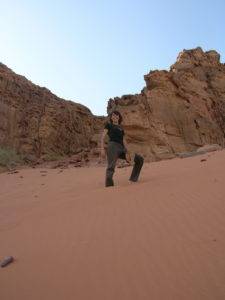
Holly in the Jordanian desert

Life of a Traveling Player or What We Do for Art

Ever since the sun set on separate campfires, people—my people—have made their way from one grouping to the next, weaving the enchantment that is a performance. We often have a home fire, a community in which our relationships with others are more solidified and our responsibilities more divergent, but we are successful because we roam, and that open road/distant mountain/rippling sea whisper sweet nothings into our ears the whole time we are at home, calling us back out into the world. Practically speaking, this way of life has several constants. One is that we work hard to offer an excellent

Read More »