Got an event? Grab your friends, some archetypal and silly costumes, and do some mumming!
WHAT IS MUMMING?
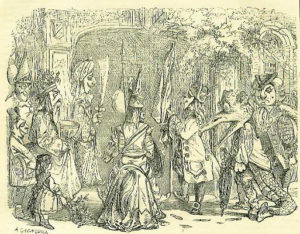
Mumming arises out of the same tradition as sword dances, and ethnohistorians believe they grew out of ancient agrarian societies, with a ritualized sacrifice to ensure the renewed fertility of the land and the people ….the battle between the old and new year, between winter and spring, between the darkness and the light. In the past 200 hundred years and in modern times, a group of Mummers might perform for members of a household, people on the street, people at an event (especially things like a wedding), or a group of families gathered together in celebration most commonly for/on the Twelfth Day of Christmas.
Typically, an event with Mummers also includes singing, dancing (group dancing, folk
dancing and with Morris Dancers), and relevant storytelling, either by elders or recognized storytellers. The Mummers themselves might be working from an ancient bit of script, a modern version of a medieval script, or a structured improvisation with stock characters pertinent to the event.
HOW DO I BEGIN?
A script or clearly structured improvisational outline!
Most ‘scripts’ have –as Wikipedia will tell you– a Doctor, George (Prince, Sir, King, Knight, whatever), the Turkey/Turkish Knight, and often a clown and/or Father Christmas to work the crowd, drive the (limited) narrative, and provide local topical commentary and audience interaction. Someone is killed and brought back to life by the Doctor.
Similarly, an event-specific ‘script should include stock, archetypal characters from that event (bride and bridegroom, and a weeping mother for a wedding, camp leaders, counselors, sports leaders, cooks, et cetera for a camp Closing Ceremonies event) and:
* doctor or person who makes the intellectual decisions (priest, principal, nurse, acountant)
* knight or persona mostly likely to take up silly defending item (camp leader with a boat paddle? Farmer with a hoe?)
* Pretty lady (played by a guy)
* manly man (played by a lady)
* step/sword/folk/Morris dancers
Your script should be very very simple, with a character-specific problem to solve (no priest, someone killed in a ‘battle’, the MC has
gone mute), lots of comic idiocy (and the higher the social ranking of the character, the more ridiculous their actions should be and the characters on the low end of the social ladder are the smartest ones), and something mysterious and wonderful that happens as part of the solution that isn’t really explained (jumping the broom at weddings, raising of the dead in the Christmastime scripts, something magical and unexpected!).
WHAT NEXT?
Practice!
Even if it is improvisational, you should practice so people have a chance to explore their characters, develop exaggerated silly walks and swaggers, discover hilarious moments and routines, and learn what the pitfalls are going to be. It will also help you practice building suspense, keeping the energy going, comic timing, and not have any one character or section go on too long!
COSTUMES?
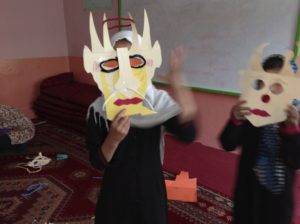
Rags, torn strips of newspaper taped or stitched on so they hang down like straw, twigs and leaves, silly, ill-fitting, mismatched or outrageous clothes … whatever is to hand will work.
ANY FINAL ADVICE?
Yes.
Remember to really include the audience! Ask questions, tell jokes, get them to help the magic moment, blame someone for farting, goofily accuse an audience member of doing something bad that you yourself did behind another character’s back.
And most importantly, HAVE FUN. This form, especially in modern times, is light and ridiculous. Think ‘mechanicals’ from A Midsummer Night’s Dream or commedia dell’arte shows, then add something sweet and sublime (which both A Midsummer Night’s Dream and commedia dell’arte have as well)!
I am having one of those days when I know what I should be doing, but I keep circling around it, nibbling on the edges of the project, but not really diving into what I know I need to do—the core work. I notice that for some reason, I am afraid….afraisd of what? Of success, of failure? I love doing this work, but I am avoding it and dreading it as though it were horribly painful to do, as though I would be risking my very self. Yet the act of ‘saving’ myself from this ‘terrible experience’ will actually sabotage my success and bring actual suffering to my life.
I find I must coax myself, not bully nor command myself (that makes it worse) and I think (I HOPE) I am picking away at it enough to tip the scales so that what remains is smaller somehow, less terrifying.
But really, what the heck?!?
Like many other people, I am susceptible to the doldrums of a northeastern North American March, when the sky is slate grey nearly incessantly, and it might be raining or sleeting or hailing or snowing…or all of the above in any given day. But I think it’s more than that. My fear of diving into this project, wherein I must breathe beautiful life into someone else’s words, someone’s dream, is (yes) partly
neurotic “I’m not good enough” artist-thinking…..but it also fear of being too vulnerable, being nearly subsumed by the tempest of the text in the sea of characters as I struggle alone in my fragile little boat.
And that and a pony will get me a pony (sigh).
I will now fortify myself with hot chocolate and dip back in to this work, sending out a “halloooo” to all you other artists out there having a blue grey work day….soldier on, friends. What else is there to do?
This past weekend, I met a man who is a jouster (sigh!). I had been invited to join a joust-training team years ago, but the commute was too far to make it work, and I had been PINING to do it ever since. I have always loved adventurous, physical things, and I do enjoy both sword fighting for stage and horse-back riding. So of course I want to joust, right? Doesn’t matter that I am female, relatively small or just had a mid-forties birthday….oh crap, maybe that last one does matter.
For the first time in my life, I am wondering if I may, in fact, be too old. If maybe my hardcore determination and Jack Russell ferocity are not enough to carry me through. Of course, I resisted this idea whilst I was talking with the 6’2”, 32-year old blacksmith/jouster, and we are going to meet in a couple weeks to whack each other with swords…. but I am actually a little worried about saving face as well as saving my face and, well, being able to actually get back up swiftly.
As always, I have looked to other artists for inspiration, artists whose bodies define their career. How did they deal with age? Do less, do differently? Is aging actually only defined by loss, or is something gained as well?
I have opted for the Mikhail Baryshnikov version of getting older.
When I was a child living outside Saratoga Springs, NY, Baryshnikov defected from Soviet Russia and became a premier dancer with the NYC Ballet and the American Ballet Company. It was rumored that he redefined what “leap” meant.

It was rumored that he was captivating and powerful in ways never before seen in American ballet . . . and it was rumored that his debut might happen during the Ballet’s summer residency in Saratoga. Then my mom got a tip—Misha might debut in a matinee performance of Coppelia the following day! We went, and
sure enough, a small slip of mimeographed paper announced the replacement of the primary male dancer that day by Mikhail Baryshnikov. Needless to say, all the other rumors were true as well. The man soared and flew, and we watched, hardly believing our eyes as his raw power revealed itself.

then, and I wondered as the lights went down if I would feel remorse at a loss of his tremendous power…. until he began to dance. Full of a richer power and exquisite grace, he did not seek to recapture the sky as he had in his youth, did not try to reproduce a lesser version of a previous self, but rather continued to redefine dance itself, explore what ‘power and grace’ mean. It was mesmerizing.
Fast forward again about 20 years to the present time. I had not thought about Misha in quite some time until I happened to note a friend’s post on Facebook. She lives in Hartford, CT and had posted the review for a theater production at the Hartford Stage Company; Man in a Case by Anton Chekhov and starring….Mikhail Baryshnikov.
Here’s an excerpt from a review in The Hartford Courant:
“Watching Mikhail Baryshnikov on stage performing in a tale about the only man — a strange, repressed and fearful Greek teacher — in a rural Russian village who can’t dance may be frustrating for some audiences. But this legendary artist still moves like a dream, which is an apt metaphor for this woozy, sly and theatrically adventuresome kind of story telling.”
I have included two more excerpts from reviews in the Post Script to this blog, but suffice to say, they all speak of Misha once again creating new meaning and expression of power, one which includes textured, subtle impact, seasoned with his irrepressible grace.
Okay, so maybe I am no longer able to learn something like Parcours, nor use brute force and ferocity to excel in a male dominated physical performance medium. But I can use my years of training and learning to find textured, subtle, impactful alternatives, both on stage and, so help me gods, in the medium of Live Steel, where the parameters/rules keep participants relatively safe but the fighting is live and the jousting is for keeps. I can redefine ‘power and grace’ for myself.
Thanks, Misha.
For those who wish to see a wonderful retrospective, here’s a link to when Mikhail Baryshnikov was honored at the Kennedy Center in 2000 (video link here).
Post Script
“Baryshnikov can insist all he wants that there’s no dancing in “Man in a Case.” But perhaps one of the most moving scenes in the play involves a scene where the character Baryshnikov plays in the second half of “Man in a Case” recounts how he fell in love with another man’s wife one day. Soon after, he and the woman (played to perfection by Tymberly Canale) slowly dance on stage. No words are spoken. But in just a matter of seconds, we can see why these two characters are torn over what to do after moving in unison in silence.”–Springfield Republican
“ Baryshnikov is of course the big draw and he infuses his characters with an unexpected modesty and grace, and in “Man in a Case” with a bit of stoic foolishness. As the suitor of the married lover, he is a bit more lively, but his sense of frustration and resignation can be palpably felt. While there is not a lot of outright dancing per se, one appreciates the carefully modulated movement that dominates nearly every scene. It may take a while to enter the special world created by Parson and Lazar, but the end result is a unique experience that continually piques your interest while revealing new and effective ways to capture a narrative.” –The Examiner
“In comes I, Old Father Christmas. Am I welcome, or am I welcome not?”
So begins many a mummers’ play as the erupt into the room in celebration of Twelfth Night!
Twelfth Night, when children and fools are kings, and bosses and adults are fools and children, when the forces of Light and Dark meet in a climactic moment, the night of the Three Kings, and the event for which Shakespeare wrote a wonderful play…..and which, in many parts of North America and the British Isles, includes MUMMERS.
What the heck are Mummers?
Wikipedia says “Mummers Plays (also known as mumming) are seasonal folk plays performed by troupes of actors known as mummers or guisers (or by local names such as rhymers, pace-eggers, soulers, tipteerers, galoshins, guysers, and so on), originally from the British Isles (see wrenboys), but later in other parts of the world. They are sometimes performed in the street but more usually as house-to-house visits and in public houses.
Although the term mummers has been used since medieval times, no play scripts or performance details survive from that era, and the term may have been used loosely to describe performers of several different kinds. Mumming may have precedents in German and French carnival customs, with rare but close parallels also in late medieval England.”
As a performer and performance historian, my perspective on mumming is a little different. Certainly, most ‘scripts’ have –as Wikipedia will tell you– a Doctor, George (Prince, Sir, King, Knight, whatever), the Turkey/Turkish Knight, and often a clown and/or Father Christmas to work the crowd, drive the (limited) narrative, and provide local topical commentary and audience interaction. Someone is killed and brought back to life by the Doctor. BUT Wikipedia –and many others– seem to think than a ‘script’ defines a Mummers’ performance, rather than what it truly does, which is provide a frame of a flying machine, a set of characters and interaction within a rough outline that lift performers into a divine state of humorous and tender interaction with whomever is the ‘audience’–members of a household, people on the street, storytellers and families gathered together or singing, dancing, and storytelling in celebration of the Twelfth Day of Christmas.
Mumming arises out of the same tradition as sword dances, and ethnohistorians believe they grew out of ancient agrarian societies, with a ritualized sacrifice to ensure the renewed fertility of the land and the people ….the battle between the old and new year, between winter and spring, between the darkness and the light.
Friday, January 11th, I will return to more detailed blogs, but in the meantime, check out these AWESOME LINKS !!! Folk Plays/ Mummers
And if anyone wants my adapted-integrated script that we used for many years, feel free to email me for a pdf at Shearwater Productions.
Happy 2013!
I normally post on Friday or the weekend, but the 21st through today have been so full!
So many celebrations that begin in late fall and run into dead of winter are about finding (or becoming/bringing) light in the darkness, both literally and metaphorically. One of my favorite stories is Raven Brings the Light, of which there are many versions.
A beautiful version was performed for Northern Exposure, in an episode is called “Seoul Mates”. (It weaves together a variety of winter solstice themes, and ends with a Raven pageant) You can find the pageant excerpt on Youtube here.
Below I have reprinted from Native Online a wonderful version,and here are links to three other versions; one Haida, one Tlingit, and one a play by Diana Knopp performed by Kerri Peters’ second graders in Whitehorse, Yukon. First Raven image by Billy Bedard, second by Paul Windsor.
May your heart be filled with light.
There was a time many years ago when the earth was covered in darkness. An inky pitch blanketed the world making it very difficult for anyone to hunt or fish or gather berries for food. An old man lived along the banks of a stream with his daughter who may have been very beautiful or possibly quite homely. This didn’t matter to the old man however because after all it was dark and who could tell.
The reason why the world was dark had to do with the old man who had a box that contained a box that held many other boxes. In the very last box was all the light in the universe and this was a treasure he selfishly kept to himself.
The mischievous Raven existed at that time because he always had. He was none too happy about the state of the world for he blundered about in the dark bumping into everything. His interfering nature peaked one day when he stumbled by the old man’s hut and overheard him muttering about his boxes. He instantly decided to steal the light but first had to find a way to get inside the hut.
Each day the young girl would go to the stream to fetch water so the Raven transformed himself into a tiny hemlock needle and floated into the girl’s bucket. Working a bit of his “trickster” magic, he made the girl thirsty and as she took a drink he slipped down her throat. Once down in her warm insides he changed again; this time into a small human being and took a very long nap. The girl did not know what was happening to her and didn’t tell her father.
One day the Raven emerged as a little boy child. If anyone could have seen him in the dark, they would have noticed that he was a peculiar looking child with a long beaklike nose, a few feathers here and there, and the unmistakably shining eyes of the Raven. Both father and daughter were delighted with their new addition and played with him for hours on end.
As the child explored his new surroundings he soon determined that the light must be kept in the big box in the corner. When he first tried to open the box, his grandfather scolded him profusely which in turn started a crying and squawking fit the likes of which the old man had never seen. As grandfathers have done since the beginning of time he caved in and gave the child the biggest box to play with. This brought peace to the hut for a brief time but it wasn’t long until the child pulled his scam again, and again, and again until finally only one box remained.
After much coaxing and wailing the old man at last agreed to let the child play with the light for only a moment. As he tossed the ball of light the child transformed into the Raven and snatching the light in his beak, flew through the smoke hole and up into the sky. The world was instantly changed forever. Mountains sprang into the bright sky and reflections danced on the rivers and oceans. Far away, the Eagle was awakened and launched skyward – his target now clearly in sight.
Raven was so caught up in all the excitement of the newly revealed world that he nearly didn’t see the Eagle bearing down on him. Swerving sharply to escape the outstretched talons, he dropped nearly half of the ball of light which fell to the earth. Shattering into one large and many small pieces on the rocky ground the bits of light bounced back up into the heavens where they remain to this day as the moon and the stars.
The Eagle pursued Raven beyond the rim of the world and exhausted by the long chase, Raven let go of what light still remained. Floating gracefully above the clouds, the sun as we now know it started up over the mountains to the east. The first rays of the morning sun brought light through the smoke hole of the old man’s house. He was weeping in sorrow over his great loss and looking up, saw his daughter for the first time.
She was very beautiful and smiling, he began to feel a little better.